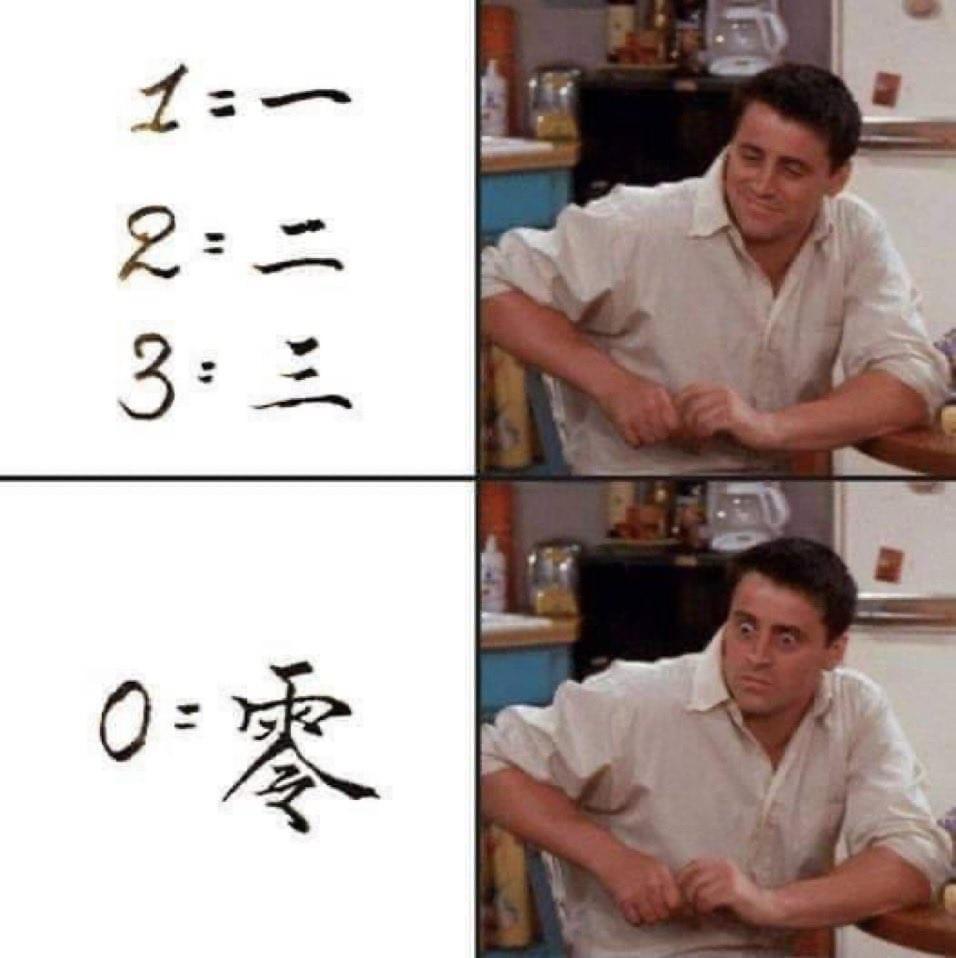
To be fair, zero is a complicated number
wdym complicated? it’s easy!
壹貳參肆伍陸柒捌玖拾 see? easy!
ITT, a bunch of people who know literally nothing about this subject offering explanations.
The character 零 (“líng”) contains a semantic component (on the top) and a sound component (on the bottom), the semantic component is 雨, meaning rain, and the sound component is 令 “lìng”.
The word initially referred to very light rain and so the character essentially means “the type of rain that sounds like lìng”. For whatever reason the meaning drifted from very light rain towards “barely any” and then “nothing/zero”.
The bottom/top usage is simple, the “zero” is the receiving hole and the “one” is the penetrating appendage, i.e. the submissive versus the dominant partner. That usage is definitely slang, though!
It’s a dude with his hands on his hips and his shadow beneath him.
I’m sure the chinese have equivalent memes about having to learn arabic numbers, at least you don’t have to use it in written out numbers, 20 is 二十, two-ten, 200 is 二百, two-hundred, 2000 is 二千, two-thousand, 200,000 is 二十万, two-hundred-thousand.
There less memorizing irregular words like twelve and X-teen and converting 30 to thirty, since it’s all pronounced as written.
Japanese pronounces some numbers different depending on what you are counting. Is this the same for Chinese?
I think there are certain phrases found in different dialects of Chinese. In Cantonese, the formal way of reading twenty is 十二, but the colloquial term would be 廿.
Edit: Should be 二十
No, but whenever you have something that’s countable (even if it’s just 1), you have to do <number> <measure word> <thing>, so instead of “I have a ticket” or “we want 2 waters”, you have to do “I have 1 <measure word for flat things> ticket” or “I(plural) want 2 <measure word for cups> water”.
There’s a generic measure word, but I think it’s seen as improper to use it.
Yea, Chinese people understand when you do that, but they first look at you with this confused look thinking ‘he wants two chopstic pieces?’ and then realize you have a vocabulary of a two-year-old.
Source:lived in China long enough to learn yo ask for things, but not long enough to learn the countable nouns.
I mean I kind of get it, it’s symbol based, and the symbol kind of looks like an all consuming void sucking things up, a representation of the absence of things