
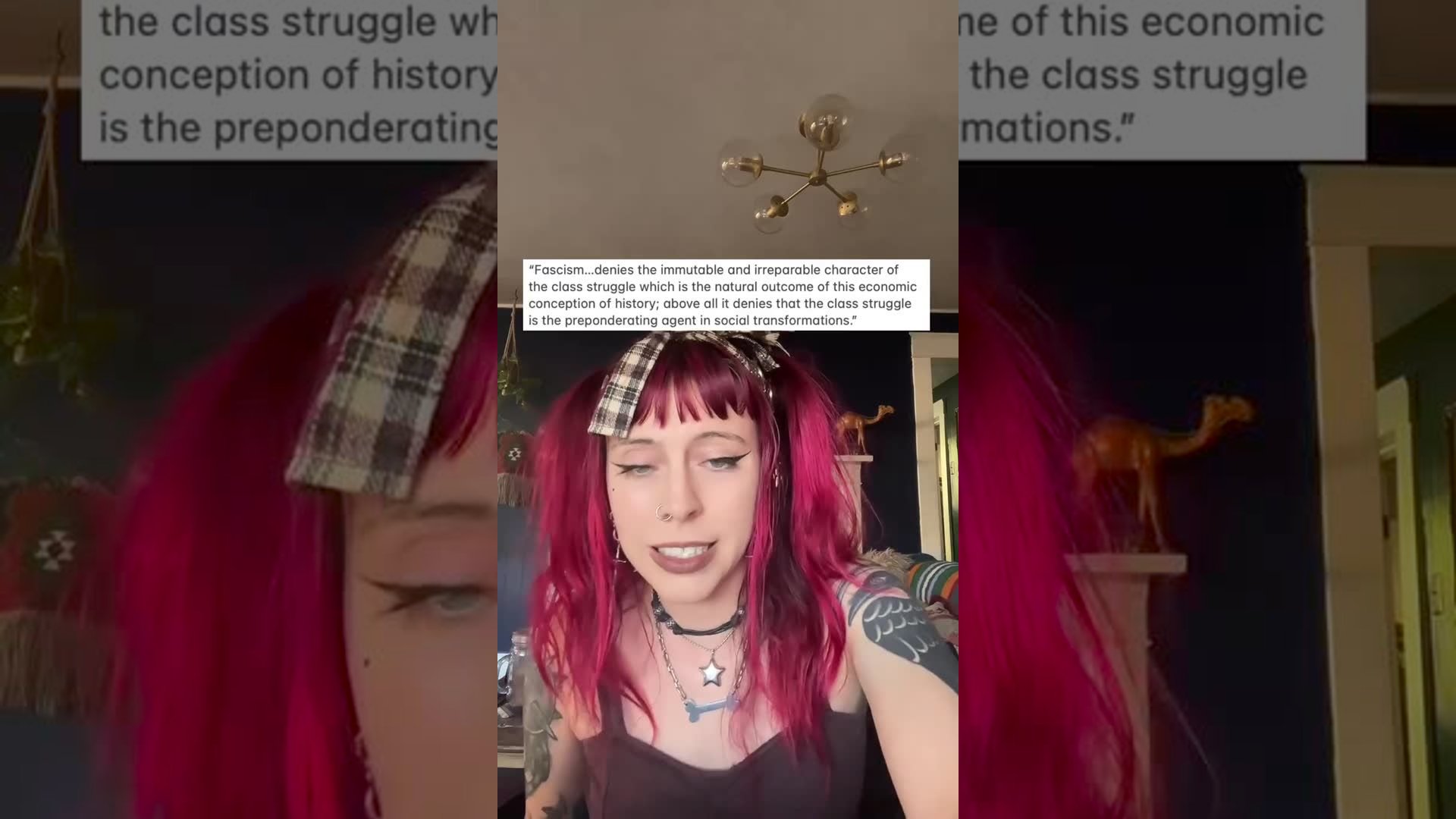
I don’t like this definition, have your own, but this feels wrong on multiple points. I didn’t want just to down-vote but explain myself even if I feel this is not “smart” of me.
- I doubt we should define an ideology from the politician(s) claiming it : especially from far-right people, they could use socialism or any other concept for or against (yes I am referring the Nazi being national-socialist too). This is debatable of course but first I wanted to point this.
- Trying to anchor the definition of an idea in a specific era-people is wrong : I don’t mind explaining that “our” concept or racism isn’t the same as 10, 20, 50 or 100 years ago, same should by our concept of fascism. At the time Mussolini coined the term in reference of antique Rome the concept actually pre-existed and was already in full power in the previous century. If we have a word for it now, nice, but its definition shouldn’t be that fixed (and from a right-wing politician) because it will, and I’d argue it already is, disconnected from current reality.
- This last point goes in-hands with my previous one. Materialism should be the analysis of things in their movements not in a perceived static “state” : this was fundamental to Marx and Engels and all the communist movements so far. We should, we have to evolve and adapt our concept to reality, not only “update” to current day but analyze the fascism as a process and not a state.
Lastly because all of this is kind of semantic discourse (talking about word definition), I strongly think that giving a definition alone isn’t that great but we need to see the consequence of the definition of the concept itself in/for our actions (here I am thinking of the concept of dialectic materialsm).
This 10-points definition not only could be attributed to other ideology (not all the points obviously) but misses what to do with that. Let me try to be clear : I’d argue that fascism is the process of the bourgeoisie taking power over societies. From here a lot of western country are fascist countries, with fascist political leaders and fascist constitution. The whole system is made for money/private property to be the real power, the corner-stone of all rights and it seems that what is happening systematically in all of those countries is not a failure but it is done by design. Also that means that we should fight, not only the parties, but the constitutions and rules of anything that “protect” private property and money.
I don’t mind discussing definition, and even not agreeing, I want to argue that we should look at the consequences of any definition, like if you define “fascism” in any way then what/who is fascist and what to do.
Bourgeoisie already have power in any capitalist society because they are the ruling class under capitalism. Fascism is what happens when the mask of liberalism drops and the ruling capitalist class has to resort to naked repression to keep their power. Hence the points she lists are to do with the narrative fascists use to justify the social relations.
Fascism is what happens when the mask of liberalism drops and the ruling capitalist class has to resort to naked repression to keep their power.
This I can agree with, and the whole mask exists because the ruling class doesn’t have all the power and the “has to resort” is also an other part of the fact that it (ruling class) is taking more power than before. So the ruling class do not need all the power all the time, hence it likes to bring a mask of “democracy” by giving some to the proletariat. Like the justice system is not run by the bourgeois directly, much like proletariat aristocracy (aka bosses, managers, etc) and if/when the system is not acting as they should it takes back this power.
You can see such power dynamic before, during feudalism, where not everything was centralized but it “eventually” went there (at different places at different time).
And other bad consequences of this very specific 10-points analysis is that many are highly subjective and are used from right-wing to attack socialism so…
All of this is still very anti-marxist in essence to me, not that is is made from bad faith, but it is not made from the analysis for the systems in motion, the power dynamics nor grounded in science. If sociologist would step up and make scientific evidence of those points being specific to such concept to define the limit between fascism and anything else (and I don’t mean “1 American study” science but international consensus) I would revise my line, not that this is 100% disconnected from reality, more that it doesn’t describes current phenomena.
Also to push for such an analysis on fascism it would be nice to have other “content” to illustrate how this definition applies correctly, both to describes what is happening now but also how robust it is as it is not describing other political movements.
I disagree they’re taking more power, what changes is the expression of power. During the good times, there’s no need to repress in overt fashion because the working class buys into the narrative. So, some freedoms can be allowed because workers are docile. When there is an economic crisis, the worker unrest starts, and that requires more direct measures to put down. However, the power was always with the ruling class.
Other systems such as feudalism share aspects with capitalism. There’s no contradiction here. One system evolved out of the other, and necessarily has shared characteristics as a result. Just like socialism retains aspects of capitalist society as well.
Meanwhile, arguing that these points will somehow be co-opted by the right-wing is a stretch.
I don’t really see anything anti-Marxist in explaining how the fascist narrative works. Madeline Pendleton clearly has a firm understanding of Marxism, as is clearly evident from her other videos where she talks about theory. The goal of this video was to focus on the narrative that fascists use.
Other systems such as feudalism share aspects with capitalism.
I think you misread, this was just an illustration of the “taking power”, “One system evolved out of the other” does not answer, nor contradict my point, I know and agree with the evolution of societies from slavery to feudalism to capitalism to communism.
Meanwhile, arguing that these points will somehow be co-opted by the right-wing is a stretch.
I feel like you might be thinking about USA, because some European countries it is not a stretch I don’t want to DOX myself too much but the “antifa is the real fascism” is a thing. I don’t mind you arguing about that because this is not even a debate in those places. I guess the USA right-wing didn’t use that rhetoric.
I don’t really see anything anti-Marxist in explaining how the fascist narrative work
It is not anti-Marxist to explain how fascist narrative works, “how” it is done here is not following the core principles of the dialectical materialism as I tried to explain with points and sentences. Maybe my English is too broken so I’ll borrow the 2nd sentence of wikipedia “it proposes that the world is material, that all phenomena are the result of matter in motion” (https://en.wikipedia.org/wiki/Dialectical_materialism), this is just an introduction but the “motion” part was not a detail but fundamental.
This video reminds me of the points of Umberto Eco (https://en.wikipedia.org/wiki/Ur-Fascism) and from where I come from there may be still some debates but most of the Marxists wouldn’t use that definition. I think this 1995 publication didn’t help, quiet the opposite, and we are getting out of it.
My point was that the right will always smear the left. What people on the left say is not going to change that one way or the other.
And I’m quite familiar with how dialectical materialism works having written a whole essay on the subject, which I dare say is a better intro than the wikipedia entry https://dialecticaldispatches.substack.com/p/the-toolset-of-reality
What I’m saying is that the video doesn’t discuss the mechanics of fascism, but rather how fascists see themselves and the narrative they use to promote their ideology. Understanding that is just as valuable as understanding how fascism function in technical terms.
